 ⌕ Zoom
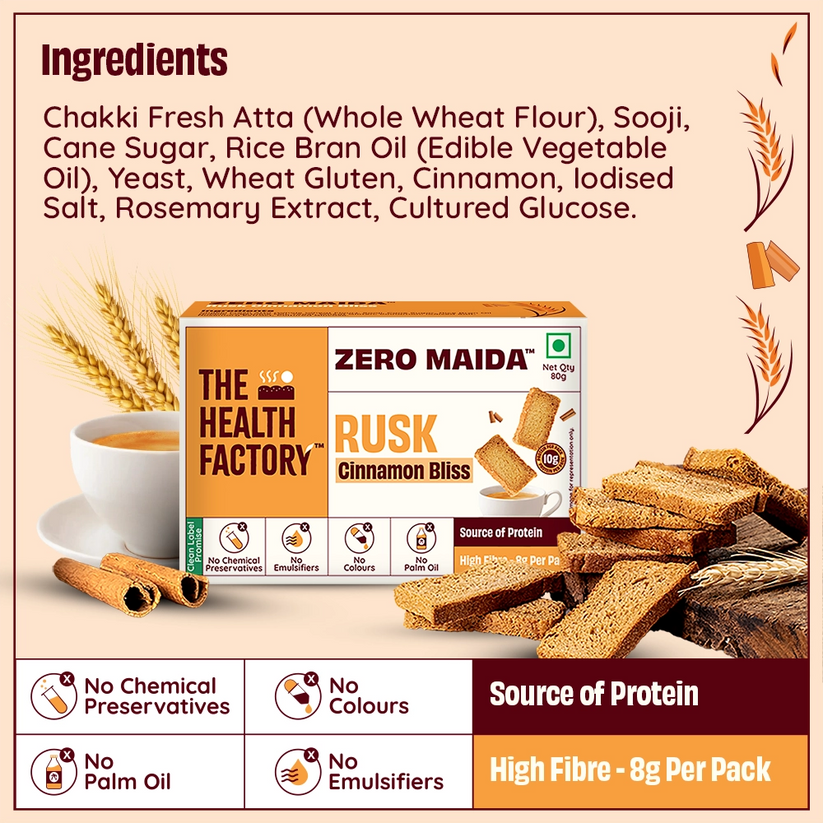
Photo from the brand's official website
Each ingredient gets a tier from our researched dossier. The list sorts worst-first; the donut summarises the distribution. Tap any ingredient for its full dossier.
We treat each claim as a question — does what’s inside back it up? Tap a claim for the reasoning.
This rusk is likely purchased by health-conscious urban Indian consumers seeking a 'maida-free' biscuit-style snack. The product genuinely avoids refined flour, synthetic emulsifiers, artificial colours, and palm oil — and its natural preservatives (rosemary extract E392 and cultured glucose) keep the synthetic-additive list clean. However, the presence of those two preservative-category ingredients technically pushes the product into NOVA 4 (ultra-processed) territory, and the label's 'Clean Label Promise' sits in tension with added wheat gluten and fermentation-derived biopreservatives. A significant data anomaly exists: the nutrition panel printed per 100 g on the pack and the actual per-100 g values in the raw label data differ substantially — the main intake data (e.g. 71.56 kcal, 12.73 g carbs) match a 16 g serving, not 100 g — suggesting a labelling or OCR error that consumers and regulators should note. The single most useful takeaway: this is a better-than-average rusk for most adults, but it is not suitable for anyone avoiding gluten, and the cinnamon type (cassia vs. Ceylon) is undisclosed, which matters for children and those with liver conditions.