Each ingredient gets a tier from our researched dossier. The list sorts worst-first; the donut summarises the distribution. Tap any ingredient for its full dossier.
Caution · 1 ingredient shown
Caution1 of 6 ingredients
CoffeeCaution
Cleared 5▾
Whey Protein Blend (Lecithin) [Whey Protein Isolate 42.0%, Whey Protein Concentrate 37.1%]Cleared
DatesCleared
Whole Milk PowderCleared
BromelainCleared
Monk FruitCleared
Unknown
02 — Claims audit
Every label claim, fact-checked.
We treat each claim as a question — does what’s inside back it up? Tap a claim for the reasoning.
17/20
claims fully supported
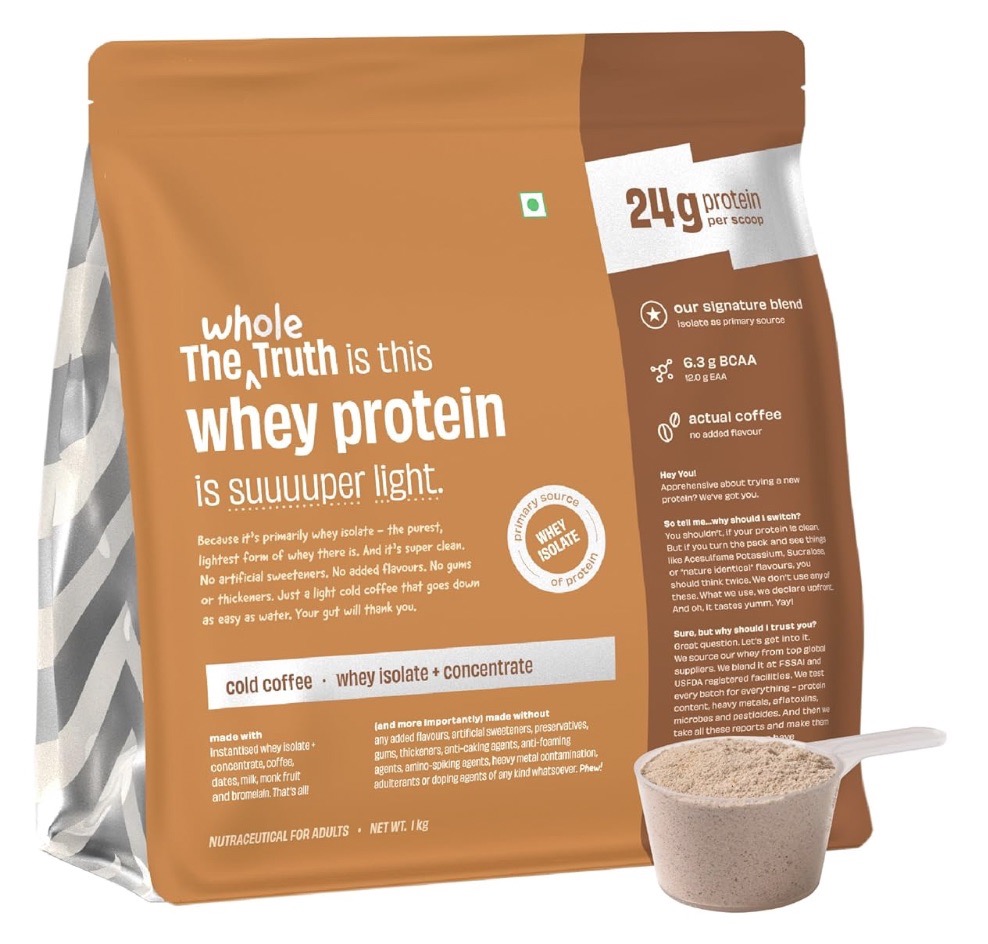
“Cleanest Protein. Ever.”unverified
The product has a short, largely whole-food ingredient list with no artificial additives, but 'cleanest ever' is an absolute superlative with no defined standard or comparative benchmark available in the data.
“No added flavours”true
Flavour comes from coffee (5.4%) and dates — both whole-food ingredients. No flavouring agents or extracts are listed in the ingredient breakdown.
“No artificial sweeteners”true
The only sweetener is monk fruit extract (0.1%), a natural high-intensity sweetener. No artificial sweeteners (sucralose, aspartame, acesulfame-K, etc.) appear in the ingredient list.
“No preservatives”true
No preservatives appear anywhere in the ingredient list or breakdown.
“No gums”true
No gums (xanthan, guar, carrageenan, etc.) are present in the ingredient list.
“No thickeners”true
No thickeners are listed in any ingredient or breakdown field.
“No anti-caking or anti-foaming agents”true
No such agents appear in the ingredient list or breakdown.
“No amino-spiking agents”true
Ingredient list contains no standalone cheap amino acids (taurine, glycine, creatine, etc.) added to artificially inflate nitrogen readings. Glycine (0.4g) in the amino acid profile is naturally occurring from whey.
“No heavy metal contamination”unverified
No heavy metal test results or certificates of analysis are provided in any of the four data sources. Trustified certification is mentioned but its scope regarding heavy metals is not detailed.
“No adulterants or doping agents of any kind whatsoever”true
The product caveat explicitly states 'Contains no doping ingredients (as per WADA/NADA list)' and the product carries Trustified blind certification, supporting this claim.
“Less than 0.1% Lecithin”true
The ingredient breakdown confirms 'Less than 0.1% lecithin' explicitly, and lecithin appears as a sub-component within the whey protein blend rather than a standalone ingredient.
“Less than 1% Bromelain”true
Ingredient breakdown confirms 'Less than 1% Bromelain'; ingredient list shows 0.6%.
“24g protein per scoop”true
Nutrition data shows 24.8g protein per 35g serving, which rounds to 24g and is consistent with the claim.
“6.4g BCAA”true
Amino acid profile confirms leucine 3.4g + isoleucine 1.4g + valine 1.6g = 6.4g BCAA per 35g serving, matching the extra information field exactly.
“12.2g EAA”true
Summing all nine essential amino acids from the profile: histidine 0.4 + isoleucine 1.4 + leucine 3.4 + lysine 1.8 + methionine 0.5 + phenylalanine 0.7 + threonine 2.3 + tryptophan 0.1 + valine 1.6 = 12.2g, matching the extra information field exactly.
“Contains no doping ingredients (as per WADA / NADA list)”true
Explicitly stated in product caveats and supported by Trustified blind certification. No banned substances appear in the ingredient list.
“Most easily digestible protein (No bloating or gas)”misleading
Bromelain (a digestive enzyme) is included at 0.6% and WPI is low in residual lactose, both of which support digestive tolerance. However, 'most easily digestible' is an absolute superlative with no comparative clinical evidence provided, and 'no bloating or gas' is an absolute outcome claim that cannot be confirmed from ingredient data alone.
“ISO, HACCP, GMP and US FDA certified facility”true
The sourcing field in extra information explicitly states 'Blended in-house at an ISO, HACCP, GMP and US FDA certified facility.'
“Every batch tested for purity”true
Testing claims field confirms 'Every batch tested for purity' using NABL-accredited lab with Kjeldahl method.
“100% blind certification program by Trustified”true
Certifications field lists 'Trustified India's first and only 100% blind certification program', confirming this claim.
03 — The fuller picture
Read the whole thing if a one-line verdict isn’t enough.
What’s in favour, and what’s working against it
In favour
Very high protein: ~24.8g per 35g serving (~71g per 100g)
Zero added sugars; all sugars are naturally occurring
No artificial sweeteners, colours, or preservatives
Complete BCAA profile: 6.4g leucine+isoleucine+valine per serving
Bromelain enzyme included to support protein digestibility
Working against
NOVA 4 (ultra-processed) due to lecithin emulsifier and monk fruit sweetener
Contains caffeine via coffee (5.4%): unsuitable for children, infants, and during pregnancy
Dates contribute natural sugars (~4g per serving); caution for diabetics
Whole milk powder adds saturated fat; caution for heart disease
Contains milk allergen; may contain tree nuts (cross-contamination)
Who should approach with care
Pregnancy — Coffee (5.4%) contributes caffeine, and EFSA recommends pregnant women limit caffeine from all sources to 200mg/day; bromelain's safety in pregnancy is also unestablished with historical concern about uterine stimulation.
Lactation — Caffeine from coffee passes into breast milk and may cause irritability or disrupted sleep in breastfed infants; bromelain safety during breastfeeding has not been established.
Infants — Coffee (5.4%) makes this product inappropriate for infants, as caffeine metabolism is severely limited in newborns; whole milk powder and unsupervised whey protein supplementation are also not suitable for infants under 12 months.
Children — Caffeine from coffee may easily exceed EFSA's safe limit of 3mg/kg bw/day for children and adolescents, potentially adversely affecting the developing central nervous system.
Diabetes — Dates (9.5%) are a concentrated source of natural glucose and fructose (>70% sugars by weight of the date fraction); individuals with diabetes or pre-diabetes should monitor blood glucose response and practice portion control.
Hypertension — Coffee intake has been associated with steeper age-related blood pressure increases in men per EFSA's 2015 opinion; individuals with hypertension should monitor their response to the caffeine contributed by this product.
Kidney Disease — This product delivers a very high protein load (~24.8g/serving) from WPI, WPC, and whole milk powder, all of which increase renal nitrogen and phosphorus burden in individuals with chronic kidney disease.
Liver Disease — Individuals with severe hepatic impairment (e.g., hepatic encephalopathy) may have reduced capacity to metabolize the high protein load from WPI and WPC; medical supervision is warranted.
Heart Disease — Caffeine from coffee may induce cardiac arrhythmias in susceptible individuals per EFSA; bromelain may potentiate anticoagulant/antiplatelet medications; and whole milk powder contributes saturated fat warranting caution in those with cardiovascular disease.
Epilepsy — Caffeine from coffee (5.4%) is a CNS stimulant that may lower seizure threshold in some individuals with epilepsy.
Lactose Intolerance — Whole milk powder retains the full lactose content of cow's milk and will reliably trigger gastrointestinal symptoms in lactose-intolerant individuals; WPC may also carry residual lactose.
Phenylketonuria — WPI, WPC, and whole milk powder all supply phenylalanine as part of their complete amino acid profiles; individuals with PKU must account for all dietary phenylalanine under strict medical and dietetic supervision.
Ibs — Dates are high in fructose and FODMAPs which may worsen IBS symptoms; coffee stimulates gut motility and acid secretion; and bromelain's proteolytic activity may also aggravate gastrointestinal symptoms in this population.
Ibd — Bromelain may aggravate existing gastrointestinal inflammation or mucosal irritation in individuals with inflammatory bowel disease per NCCIH guidance.
Gout — Coffee intake may transiently affect purine metabolism, particularly during caffeine withdrawal; individuals with gout should monitor their response to regular caffeine-containing protein supplementation.
Other — Individuals with IgE-mediated cow's milk allergy must strictly avoid this product, which contains milk allergens from WPI, WPC, and whole milk powder; those allergic to pineapple or latex should also exercise caution due to bromelain.
The full analysis
The Whole Truth's Cold Coffee Whey is aimed at fitness-conscious consumers who want a minimally-additive protein supplement: no artificial sweeteners, no gums, no artificial colours, and a short, recognisable ingredient list. At ~24.8g protein and 6.4g BCAA per 35g scoop, the protein quality is genuinely strong, third-party tested via NABL and Trustified blind certification. The most important caveat for a curious consumer is that the presence of lecithin (an emulsifier) and monk fruit (a sweetener), even at sub-0.1% levels, technically push this into NOVA 4 under ultra-processed food classification rules — a technical label that sits at odds with the brand's clean-eating positioning but reflects the letter of the NOVA framework rather than any meaningful safety concern.
FSSAI licence
11523998000637
Manufacturer
Fitshit Health Solutions Pvt Ltd
Region
IN
Source
MANUAL
Analysis
v1
Independently researched
Cold Coffee Whey Protein Isolate + Concentrate · The Whole Truth | whatsinit
 ⌕ Zoom