NOVA 4high fibrehigh proteinvery high sodiummulti-grain milletultra-processedno artificial flavourslactose-freepregnancy-safenut-freediabetic-safeenjoy in moderation
Each ingredient gets a tier from our researched dossier. The list sorts worst-first; the donut summarises the distribution. Tap any ingredient for its full dossier.
Caution · 5 ingredients shown
Caution5 of 10 ingredients
Grains (Rice, Maize, Suji, Barley)Caution
Millets (Sorghum, Pearl millet, Amaranth)Caution
Daals (Soybean, Bengal gram, Moong, Black Gram)Caution
KhaandCaution
Coconut fatCaution
Cleared 4▾
Iodised saltCleared
Lemon juiceCleared
Dehydrated vegetables (Carrots & Peas)Cleared
Vinegar powderE267Cleared
Unknown 1▾
Spices & condimentsUnknown
Unknown
Why it’s on SafeShelf
Reviewed and added to SafeShelf — every ingredient checked against our safety, regulatory and processing standards.
02 — Claims audit
Every label claim, fact-checked.
We treat each claim as a question — does what’s inside back it up? Tap a claim for the reasoning.
4/12
claims fully supported
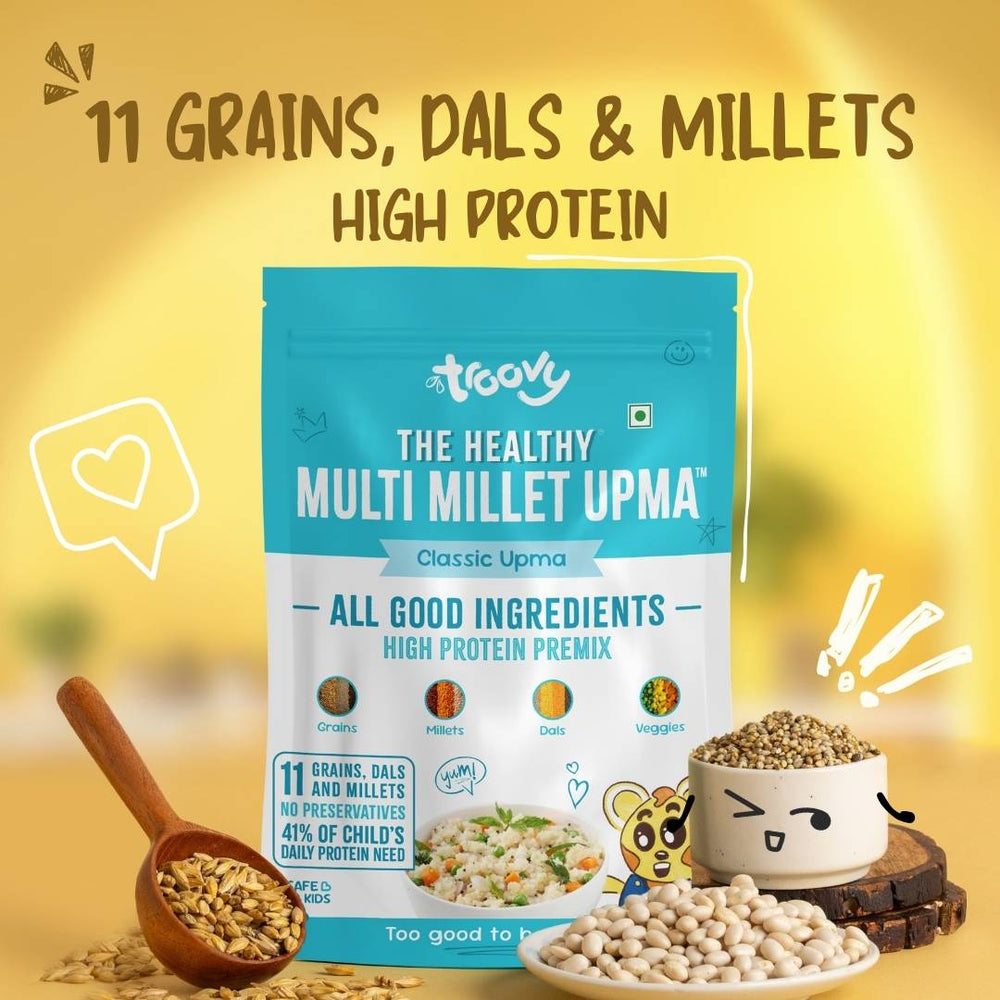
“11 Grains, Dals & Millets”true
Ingredient list confirms: 4 grains (Rice, Maize, Suji, Barley) + 3 millets (Sorghum, Pearl millet, Amaranth) + 4 dals (Soybean, Bengal gram, Moong, Black Gram) = 11. Count is accurate.
“High Protein”true
Protein is 13.58g/100g, exceeding FSSAI's threshold of 12g/100g for a 'high protein' claim. Per 70g serving it delivers ~9.5g, representing 18% of adult protein RDA (ICMR-2020) as confirmed by the brand's own RDA table.
“No Preservatives”false
Vinegar powder is listed as an ingredient and its dossier categorises it as a 'preservative' used as an acidity regulator and preservative in food manufacturing. The claim is directly contradicted by this ingredient.
“41% of Child's Daily Protein Need”true
The brand's own RDA table (ICMR-2020 for 7-9 year olds) confirms protein per 70g serving = 41% of the child's daily RDA. The underlying nutrition data is consistent with this.
“Safe for Kids”misleading
A single 70g serving provides 1,071mg sodium — 54% of a 7-9 year old's daily sodium allowance. WHO and ICMR guidance on sodium for children makes this level in a single breakfast meal a material concern. Additionally, the ingredient dossier (as received) flags Amaranth as azo dye E123, linked to hyperactivity in children, though this is likely a mis-categorisation of the grain. The claim is technically uncontested on allergen or contamination grounds but is materially undermined by the sodium burden for the stated target audience.
“All Good Ingredients”misleading
Sodium is 1,530mg/100g — among the highest for a grain-mix product. Vinegar powder is a preservative-category additive. Khaand contributes 4.5g added sugar/100g. The overall ingredient picture is mixed, not uniformly 'good'.
“High Protein Premix”true
Protein at 13.58g/100g exceeds FSSAI's 12g/100g threshold for a high-protein claim. Consistent with 'High Protein' verdict above.
“Naturally High in Protein & Fibre”misleading
Fibre (14.5g/100g) and protein (13.58g/100g) are genuinely high. However, the product is a multi-ingredient processed mix, not a single natural food; the protein and fibre arise from a formulated blend including concentrated legumes. 'Naturally' implies a minimally processed single-ingredient source, which this is not.
“Fibre as 9 apples”unverified
Per 70g serving, fibre = ~10.15g. A medium apple contains approximately 1.0–1.5g of dietary fibre depending on size and variety. Using ~1.1g/apple, 10.15g ÷ 1.1 ≈ 9.2 apples. This is approximately consistent, though the specific apple fibre reference used by the brand is not disclosed. Plausible but dependent on a small-apple baseline.
“Protein as 2.4 cups of cooked dal”misleading
Per 70g serving, protein ≈ 9.5g. A standard cup (~240ml) of cooked dal yields approximately 8–9g protein, making 2.4 cups ≈ 19–22g protein — far more than the 9.5g this serving delivers. The comparison appears significantly overstated and the specific dal type and serving size reference are not disclosed.
“41% of daily protein per serve”misleading
This is true for 7-9 year old children per ICMR-2020 (confirmed in RDA table). For adults the figure is only 18%. The unqualified claim implies adult applicability, which is not supported; it should specify 'children aged 7-9'.
“Too good to be...”unverified
Claim text is incomplete as provided; the full intended phrase cannot be evaluated.
03 — The fuller picture
Read the whole thing if a one-line verdict isn’t enough.
What’s in favour, and what’s working against it
In favour
Very high dietary fibre: 14.5g per 100g
Good plant protein from 11 grains, dals, and millets
Zero trans fats and very low saturated fat
Diverse whole-food base: rice, barley, sorghum, bajra, legumes
No added artificial colours or flavours (as declared on label)
Vegetarian and cholesterol-free
Working against
Extremely high sodium: ~1,071mg per 70g serving (54% adult RDA)
Contains vinegar powder, a preservative — contradicts 'No Preservatives' claim
NOVA 4 ultra-processed due to additive-category ingredients
Ingredient dossier flags Amaranth atom as synthetic azo dye E123 (banned in US, Japan) — likely a grain/colour misidentification but unresolved
High sodium makes it unsuitable as a daily children's staple despite child-focused marketing
Who should approach with care
Hypertension — One serving delivers ~1,071mg sodium (54% adult RDA) from iodised salt, vinegar powder sodium salts, and other sodium-contributing ingredients — well above WHO's recommended maximum for hypertensive individuals.
Heart Disease — Very high sodium per serving (~1,071mg) promotes fluid retention and cardiovascular load; iodised salt and coconut fat (high saturated fat) both compound risk for individuals with established heart disease.
Kidney Disease — High sodium (iodised salt, vinegar powder), potassium and phosphorus from multiple legumes (Bengal gram, moong, urad, soybean), and oxalates from urad dal together create a complex electrolyte burden that warrants medical oversight in chronic kidney disease.
Infants — Added salt (iodised) must be avoided in infant foods per FSSAI and WHO; the product also contains rice (inorganic arsenic concern), multiple legumes (inappropriate before 6 months), and very high sodium relative to immature renal function.
Children — While marketed at children, one serving provides 54% of a 7-9 year old's daily sodium allowance; khaand (added sugar) and the Amaranth ingredient (flagged by dossier as azo dye E123 linked to hyperactivity, though likely a grain misidentification) add further caution signals.
Pregnancy — High sodium per serving compounds fluid-retention risks in pregnancy; rice raises inorganic arsenic exposure concerns; iodised salt iodine sufficiency during pregnancy should be clinician-assessed.
Diabetes — White rice, semolina, and maize contribute high-glycaemic carbohydrates; khaand (≥90% sucrose) raises post-prandial glucose; coconut fat elevates LDL risk common in type 2 diabetes — portion control and medical guidance are essential.
Thyroid Disease — Soybean isoflavones may impair thyroid hormone synthesis and reduce levothyroxine absorption; excess iodine from iodised salt can also precipitate thyrotoxicosis or worsen autoimmune thyroid conditions.
Gluten Intolerance — Semolina (durum wheat) and barley are both gluten-containing cereals strictly contraindicated for individuals with celiac disease or non-celiac gluten sensitivity under FSSAI and all major allergen frameworks.
Ibs — Multiple high-FODMAP ingredients are present — soybean, Bengal gram, moong, urad dal (galacto-oligosaccharides), barley and semolina (fructans), and vinegar powder (residual acetic acid) — making this product likely to exacerbate IBS symptoms.
Ibd — High insoluble fibre from barley, urad dal, Bengal gram, and moong may aggravate gastrointestinal symptoms during active inflammatory bowel disease flares; medical dietary guidance is recommended.
Gout — Multiple purine-containing legumes (Bengal gram, moong, urad dal) combined with fructose from khaand sucrose hydrolysis may elevate serum uric acid and risk triggering gout flares.
The full analysis
This product appeals to parents looking for a 'better-for-you' instant breakfast for children, combining real millets, legumes, and grains to deliver genuinely high fibre (14.5g/100g) and respectable protein (13.58g/100g). However, its sodium content is the single most urgent concern: one 70g serving delivers approximately 1,071mg of sodium — 54% of an adult's daily allowance and the same proportion for 7-9 year olds per the brand's own RDA table — which is far too high for a children's breakfast product. The 'No Preservatives' claim is undermined by vinegar powder (a recognised preservative by ingredient category), and the ingredient dossier matched the 'Amaranth' in the millets blend to the synthetic azo dye E123 rather than the grain; consumers and reviewers should note this likely OCR/categorisation error, though the dossier as received flags colour-category concerns. The single most useful thing a consumer should know: this product is nutritionally interesting but its sodium level makes it inappropriate as a daily staple for children or anyone managing blood pressure.
Region
IN
Source
MANUAL
Analysis
v1
Independently researched
The Healthy Multi Millet Upma - Classic Upma · Troovy | whatsinit
 ⌕ Zoom