NOVA 4high proteinno artificial sweetenersno artificial flavoursno preservativesplant-basedlactose-freepregnancy-safediabetic-safegluten-freeenjoy in moderation
Each ingredient gets a tier from our researched dossier. The list sorts worst-first; the donut summarises the distribution. Tap any ingredient for its full dossier.
Caution · 1 ingredient shown
Caution1 of 9 ingredients
brown rice protein isolateCaution
Cleared 8▾
golden pea protein isolateCleared
pistachiosCleared
almondsCleared
date powderCleared
cardamomCleared
monk fruitCleared
bromelainCleared
curcuminE100Cleared
Unknown
Why it’s on SafeShelf
Reviewed and added to SafeShelf — every ingredient checked against our safety, regulatory and processing standards.
02 — Claims audit
Every label claim, fact-checked.
We treat each claim as a question — does what’s inside back it up? Tap a claim for the reasoning.
19/27
claims fully supported
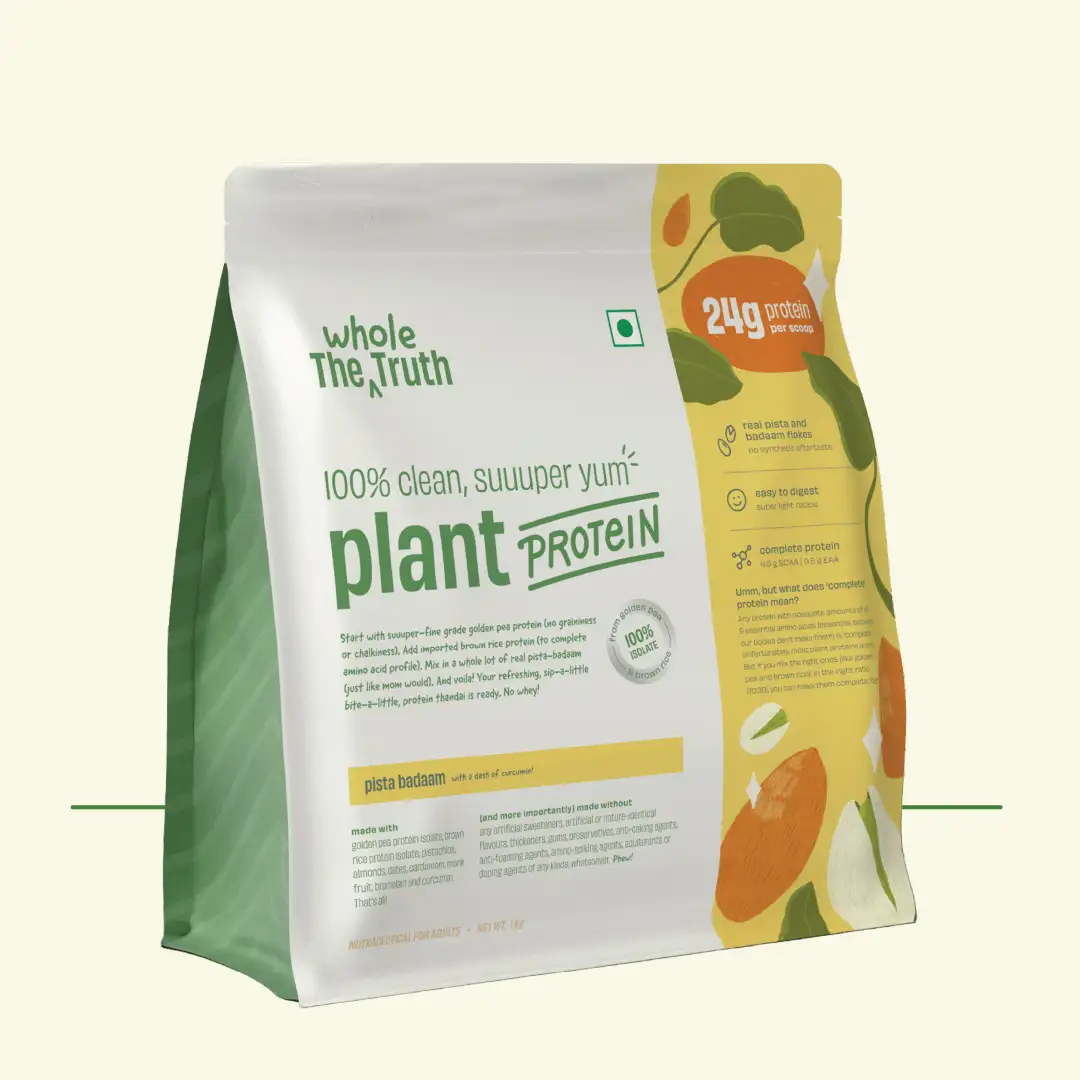
“24g protein per scoop”true
Per-100g value from rawLabelData is 63.3g protein; 63.3g × 0.38 (serving) = 24.05g — confirmed.
“4.6g BCAA | 9.5g EAA”true
Amino acid profile in EXTRA INFORMATION lists totalBCAA: 4.6g and totalEAA: 9.5g per serving.
“100% isolate from golden pea and brown rice”true
Ingredient list confirms golden pea protein isolate (50.4%) and brown rice protein isolate (21.6%) as the only protein sources; brand story confirms isolate form.
“Complete protein”true
Pea protein is low in methionine; brown rice protein complements it. The amino acid profile shows all 9 essential amino acids present (EAA total 9.5g/serving), and brand provides a detailed explanation of the blending rationale.
“Plant based”true
All nine ingredients are plant-derived; no animal-origin ingredients present.
“No whey”true
Ingredient list contains no whey or dairy proteins; product is labelled vegetarian (veg dot).
“No artificial sweeteners”true
Sweetening comes from monk fruit extract (natural origin) and date powder; no aspartame, sucralose, acesulfame-K, saccharin, or other artificial sweeteners are listed.
“No artificial or nature-identical flavours”true
Flavour comes from real pistachios, almonds, cardamom, and curcumin; no synthetic or nature-identical flavouring agents appear in the ingredient list.
“No thickeners”true
No thickening agents (e.g., xanthan gum, carrageenan, cellulose gum) appear in the ingredient list.
“No gums”true
No gums of any kind appear in the ingredient list.
“No preservatives”true
No preservatives appear in the ingredient list.
“No anti-caking agents”true
No anti-caking agents appear in the ingredient list.
“No anti-foaming agents”true
No anti-foaming agents appear in the ingredient list.
“No amino-spiking agents”true
No cheap free amino acids (e.g., taurine, glycine, creatine) added separately to inflate protein readings; protein testing was done by Kjeldahl at NABL lab.
“Gluten free”true
Brand story states each batch is tested for absence of gluten at a NABL-accredited lab; no gluten-containing ingredients are present.
“No heavy metals”misleading
Brand states batch testing for heavy metals at NABL lab; however, brown rice protein is a documented source of inorganic arsenic — whether batch results consistently pass limits is not shown. The claim is supported in intent and by declared testing, but brown rice arsenic is a recognised structural concern.
“Less than 1% bromelain”true
Ingredient list shows bromelain at 0.4%, which is less than 1%.
“Real pista and badaam flakes”unverified
Pistachios (10%) and almonds (10%) are confirmed in the ingredient list. The term 'flakes' cannot be verified from the available data — it may describe the physical form but is not confirmed.
“Contains no doping ingredients as per WADA/NADA list”true
Product caveats explicitly state 'Contains no doping ingredients (as per WADA / NADA list)'; no prohibited substance appears in any ingredient.
“No adulterants”unverified
No adulterants appear in the declared ingredient list; NABL batch testing is claimed but no certificate is available for independent verification.
“Aflatoxin free”unverified
No aflatoxin test certificate is provided in the available data; pistachios and almonds are recognised vehicles for aflatoxin. The claim cannot be confirmed without batch results.
“Easy to digest”unverified
Bromelain (a proteolytic enzyme, 0.4%) is included specifically to aid protein digestion; this is a plausible ingredient-level mechanism, though no clinical outcome data for this specific formulation is provided.
“No amino spiking”true
No free amino acid spiking agents are listed; Kjeldahl testing at NABL lab further supports protein integrity.
“No synthetic aftertaste”unverified
No synthetic sweeteners are present; monk fruit can have a slight aftertaste in some individuals. The claim is subjective and sensory-dependent.
“Super light texture”unverified
Subjective sensory claim; not verifiable from ingredient or nutrition data.
“100% clean, suuuper yum plant protein”unverified
Subjective marketing language; 'clean' is undefined and unregulated.
“Nothing to hide”true
Full ingredient list with percentages is declared; batch testing is disclosed; FSSAI licence is present. The spirit of the claim is supported by the level of transparency shown on the label.
03 — The fuller picture
Read the whole thing if a one-line verdict isn’t enough.
What’s in favour, and what’s working against it
In favour
Very high protein: ~63g per 100g (24g per 38g serving)
No artificial sweeteners, colours, or flavours
No thickeners, gums, preservatives, or anti-caking agents
Complete amino acid profile via pea + brown rice protein combination
Real whole-food ingredients: pistachios, almonds, dates, cardamom
NABL-accredited batch testing for protein, gluten, and heavy metals
Working against
NOVA 4 ultra-processed due to protein isolates and enzyme additive
Brown rice protein carries elevated inorganic arsenic risk (IARC Group 1 carcinogen in source grain)
Moderate sodium: 235 mg per serving (~11.7% adult RDA)
Contains tree nuts (pistachios, almonds) — major allergen risk
Manufactured in facility that processes milk and soy — cross-contamination risk
No ADI established for monk fruit in EU; EFSA flagged data gaps for most extract forms
Who should approach with care
Nut Allergy — Pistachios and almonds are both globally recognised major tree nut allergens capable of triggering anaphylaxis in sensitised individuals, and the product contains 10% of each.
Pregnancy — Brown rice protein carries elevated inorganic arsenic exposure risk in pregnancy; high-dose curcumin extract has been explicitly excluded from use in pregnant women by EFSA; and bromelain's safety in pregnancy is unestablished with historical concern as a uterine stimulant.
Lactation — Safety of bromelain and high-dose curcumin extract during breastfeeding has not been established; EFSA's curcumin novel food opinion excluded lactating women from recommended supplemental use.
Infants — EFSA explicitly deemed rice-derived protein hydrolysate unsuitable for infant nutrition, and brown rice protein carries disproportionately high inorganic arsenic risk relative to infant body weight; pistachios and almonds also pose choking and allergy-introduction concerns.
Children — Children consuming brown rice protein regularly face significantly elevated inorganic arsenic exposure relative to body weight; curcumin at supplement levels may also approach or exceed the EFSA ADI of 3 mg/kg bw/day in young children.
Kidney Disease — High concentrated protein intake from isolates increases renal nitrogen load; pistachios and almonds add potassium and oxalates/phosphorus burdens that may worsen hyperkalaemia or kidney stone risk in those with chronic kidney disease.
Heart Disease — Bromelain has documented anticoagulant properties that may potentiate bleeding risk in patients on antiplatelet or anticoagulant therapy such as warfarin or clopidogrel.
Liver Disease — High-dose curcumin supplementation has been associated with rare hepatotoxicity cases; individuals with pre-existing liver conditions should seek medical advice before regular use.
Diabetes — Date powder contributes more than 70% natural sugars (fructose and glucose) by composition; despite a low glycaemic index, portion-controlled use is advised and blood glucose monitoring is recommended.
Ibs — Pistachios (fructan FODMAPs), date powder (high fructose and fermentable fibre), and bromelain (proteolytic activity at the gut mucosa) may collectively exacerbate bloating, cramping, and altered bowel habits in IBS patients.
Ibd — Bromelain's proteolytic activity may aggravate existing gastrointestinal inflammation or mucosal irritation in individuals with Crohn's disease or ulcerative colitis.
Gout — Date powder's high fructose content can elevate serum uric acid levels, potentially precipitating gout flares in predisposed individuals.
Other — Individuals with known allergy to pineapple, latex, celery, fennel, or related pollens face elevated risk of allergic reactions to bromelain; those with peanut allergy should consult an allergist before use due to documented legume cross-reactivity with pea protein.
The full analysis
This product is aimed at fitness-conscious Indian consumers seeking a clean-label, whey-free protein supplement with a desi flavour profile. Its strongest selling points are a genuinely high protein density (~63g/100g), a transparent nine-ingredient list with no artificial additives, and third-party NABL testing for protein content, gluten, and heavy metals. The primary flags are its NOVA 4 classification (protein isolates and an enzyme additive push it into ultra-processed territory by definition), a moderate sodium contribution of 235 mg per serving (~11.7% RDA), and the arsenic contamination risk inherent in brown rice protein — a concern especially for pregnant women and children using this daily. The single most useful takeaway: for most healthy adults, this is one of the cleaner ultra-processed protein powders on the Indian market, but daily users from vulnerable groups (pregnancy, kidney disease, children) should seek medical guidance.
FSSAI licence
11523998000637
Manufacturer
Fitshit Health Solutions Pvt Ltd
Region
IN
Source
MANUAL
Analysis
v1
Independently researched
Pista Badaam Plant Protein · The Whole Truth | whatsinit
 ⌕ Zoom