Each ingredient gets a tier from our researched dossier. The list sorts worst-first; the donut summarises the distribution. Tap any ingredient for its full dossier.
Caution · 1 ingredient shown
Caution1 of 7 ingredients
Brown Rice Protein IsolateCaution
Cleared 6▾
Pea Protein IsolateCleared
Mung Bean Protein ConcentrateCleared
MCTCleared
Cocoa PowderCleared
Natural and Nature Identical Flavour (Chocolate)Cleared
Monk FruitCleared
Unknown
02 — Claims audit
Every label claim, fact-checked.
We treat each claim as a question — does what’s inside back it up? Tap a claim for the reasoning.
9/15
claims fully supported
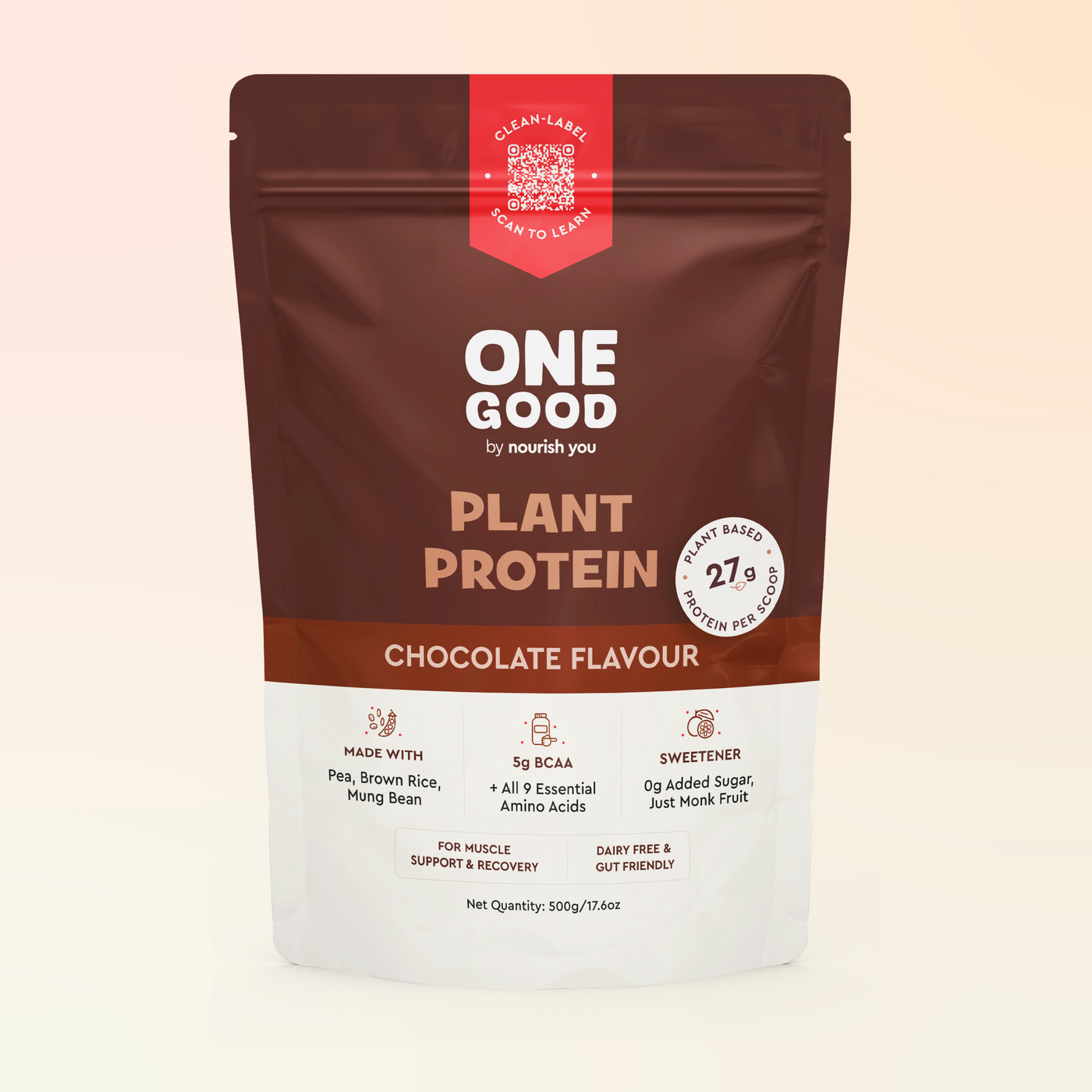
“27g Plant Based Protein Per Scoop”true
EXTRA INFORMATION nutritionPerServe36g shows proteinG = 27.36g per 36g scoop.
“5g BCAA Per Scoop”true
Amino acid profile per 36g: L-Leucine 2.35g + L-Isoleucine 1.15g + L-Valine 1.38g = 4.88g, which rounds to ~5g.
“11g EAA Per Scoop”true
Sum of all 9 EAAs per 36g from the amino acid profile: His 0.66 + Ile 1.15 + Leu 2.35 + Lys 1.81 + Met 0.33 + Phe 1.55 + Thr 0.93 + Trp 1.12 + Val 1.38 = 11.28g, consistent with the 11g claim.
“All 9 Essential Amino Acids”true
All 9 EAAs (histidine, isoleucine, leucine, lysine, methionine, phenylalanine, threonine, tryptophan, valine) appear with non-zero values in the amino acid profile.
“0g Added Sugar”true
addedSugarG = 0.00 in both per-serve and per-100g nutrition panels; monk fruit is a non-caloric sweetener, not a sugar.
“Sweetened with Monk Fruit”true
Monk Fruit is listed as the last ingredient; no other sweetener is declared.
“Dairy Free & Gut Friendly”misleading
Dairy-free is confirmed (vegan status, no milk ingredients). 'Gut friendly' is unsubstantiated — pea, mung bean, and brown rice protein concentrates retain anti-nutritional factors (lectins, phytic acid, trypsin inhibitors) and may cause bloating or GI discomfort in sensitive individuals.
“For Muscle Support & Recovery”unverified
No clinical study or cited trial is provided in any of the four data sources to substantiate a specific muscle support or recovery outcome for this product.
“Clean-Label”misleading
The product contains nature-identical chocolate flavour — a chemically synthesised flavouring compound — which is inconsistent with standard clean-label definitions that exclude synthetic additives, even though it carries no E-number.
“Say No To Artificial Sweeteners”true
Only monk fruit extract (a natural, non-caloric sweetener) is used; no artificial sweeteners (e.g., sucralose, aspartame, acesulfame-K) are present.
“Say No To Artificial Flavours”misleading
The ingredient list includes 'Nature Identical Flavour (Chocolate)', which is synthesised in a laboratory via chemical synthesis. Under FSSAI regulations, nature-identical flavours occupy a category distinct from 'natural' — they are not extracted from natural sources. Most consumers would reasonably interpret 'no artificial flavours' as excluding lab-synthesised compounds.
“Say No To Thickeners”true
No thickeners, gums, or stabilisers appear in the ingredient list.
“Say No To Heavy Metals”misleading
Brown rice protein isolate is documented in the ingredient dossier to carry elevated inorganic arsenic (an IARC Group 1 carcinogen) relative to white-rice-derived products. No third-party certificate of analysis or batch-level heavy-metal test result is available in the label data to substantiate this claim.
“Say No To Preservatives”true
No preservatives are listed in the ingredients.
“Plants Pack a Punch”unverified
Marketing tagline — not a verifiable factual claim.
03 — The fuller picture
Read the whole thing if a one-line verdict isn’t enough.
What’s in favour, and what’s working against it
In favour
Very high protein: ~27g per 36g scoop (76g/100g)
All 9 essential amino acids present with complete EAA profile
Zero added sugar; naturally sweetened with monk fruit
Dairy-free and vegan certified
No artificial sweeteners or preservatives
FSSAI licensed; manufactured in India
Working against
Brown rice protein carries elevated inorganic arsenic (IARC Group 1 carcinogen)
Ultra-processed (NOVA 4) due to synthetic flavouring compounds
Heavy metals claim unsupported — no third-party test certificate provided
Cocoa and chocolate flavourings add methylxanthines (caffeine, theobromine)
Low dietary fibre (0.39g per serve) for a protein supplement
Who should approach with care
Infants — Multiple ingredients — pea protein isolate, brown rice protein isolate (elevated arsenic), mung bean protein concentrate, cocoa powder, and natural chocolate flavour — are explicitly contra-indicated for infants due to arsenic exposure risk, methylxanthine intolerance, and lack of infant-formula regulatory authorisation; the product label itself states 'Not recommended for children below 12 years'.
Children — Brown rice protein contributes disproportionately higher inorganic arsenic exposure per body weight in children; cocoa powder and chocolate flavourings add caffeine, theobromine, and cadmium at levels approaching tolerable monthly intakes in high-percentile child consumers (JECFA/WHO 2022).
Pregnancy — Brown rice protein carries elevated inorganic arsenic (associated with adverse birth outcomes); cocoa powder and both chocolate flavouring ingredients contribute caffeine and theobromine that cross the placenta, with WHO recommending total caffeine limitation during pregnancy.
Lactation — Caffeine, theobromine, and volatile nature-identical flavouring compounds from cocoa and chocolate flavourings transfer into breast milk and may cause irritability or sleep disturbances in nursing infants.
Kidney Disease — The very high protein load (~27g per scoop from three concentrated protein isolates) plus cocoa powder's high oxalate content may exacerbate renal nitrogen load and kidney stone risk in individuals with chronic kidney disease requiring protein restriction.
Liver Disease — MCTs bypass lymphatic transport and are oxidised directly in the liver via the hepatic portal vein, imposing a direct metabolic load that may be hazardous in individuals with compromised hepatic function.
Heart Disease — MCT oil causes a statistically significant increase in serum triglycerides (2021 meta-analysis), and caffeine/theobromine from cocoa and chocolate flavourings can raise heart rate and blood pressure, warranting medical guidance for those with established cardiovascular disease.
Diabetes — MCTs produce ketone bodies via rapid hepatic oxidation, which could affect glycaemic and ketone control, particularly in type 1 diabetics susceptible to ketoacidosis.
Epilepsy — MCTs are used therapeutically in the ketogenic diet for refractory epilepsy; unsupervised MCT intake in a supplement context may unpredictably alter circulating ketone levels and interfere with seizure management.
Ibs — MCT oil (up to 85% GI adverse-event rate in clinical studies), mung bean protein's residual lectins and phytic acid, and theobromine/caffeine from cocoa and chocolate flavourings can each independently exacerbate diarrhoea, cramping, and urgency in IBS patients.
Ibd — The high incidence of GI adverse events (vomiting, diarrhoea, abdominal cramping) documented with MCT oil supplementation warrants caution in individuals with inflammatory bowel disease for whom GI tolerability is already compromised.
Migraine — Cocoa powder, natural chocolate flavour, and nature-identical chocolate flavour all contain recognised migraine dietary triggers including phenylethylamine, caffeine, theobromine, and synthetic aldehyde/pyrazine compounds.
Nut Allergy — IgE cross-reactivity between pea protein and peanut proteins is documented (both are legumes); mung bean allergens Vig r 2/Vig r 4 also share 50–51% sequence homology with peanut allergen Ara h 1 — individuals with peanut allergy should consult an allergist before use.
The full analysis
This product targets fitness-conscious, dairy-avoiding consumers seeking a plant-based protein supplement. At ~27g protein per 36g scoop the protein density is genuinely impressive, added sugar is zero, and no artificial sweeteners or preservatives are present. However, the inclusion of nature-identical chocolate flavour — a lab-synthesised compound — technically contradicts the 'no artificial flavours' and 'clean-label' positioning, depending on how consumers interpret regulatory versus plain-English definitions. Brown rice protein carries a well-documented elevated inorganic arsenic burden, making the 'Say No To Heavy Metals' claim unverifiable without third-party testing. The most useful thing a curious buyer should know: the protein payload and amino-acid completeness are legitimate, but the product is ultra-processed by NOVA criteria and the heavy-metals claim is unsupported by any certificate of analysis in the label data.
FSSAI licence
13615010000200
Manufacturer
S.D. Life Sciences India Private Limited
Region
IN
Source
MANUAL
Analysis
v1
Independently researched
One Good Plant Protein Chocolate Flavour · One Good by Nourish You | whatsinit
 ⌕ Zoom