Each ingredient gets a tier from our researched dossier. The list sorts worst-first; the donut summarises the distribution. Tap any ingredient for its full dossier.
We treat each claim as a question — does what’s inside back it up? Tap a claim for the reasoning.
6/21
claims fully supported
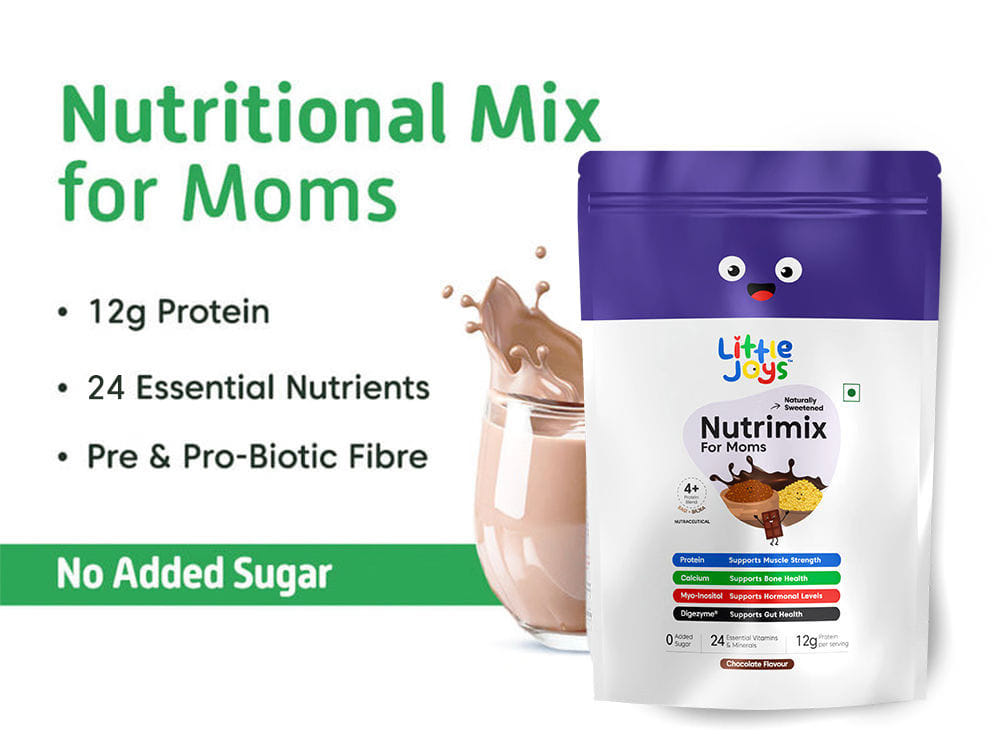
“Nutritional Mix for Moms”true
Product is formulated as a maternal supplement with protein, 24 micronutrients, DHA, myo-inositol, and probiotics — consistent with the descriptor.
“12g Protein”true
RDA table confirms protein qtyPerServe of 12.06g; front-pack highlights also state 12g protein per serving.
“24 Essential Nutrients”true
RDA table lists 12 vitamins (A, B1, B2, B3, B5, B6, B9, B12, C, D3, E, K2-7), 10 minerals (zinc, copper, iodine, calcium, chromium, selenium, magnesium, manganese, potassium, molybdenum), plus algal DHA and myo-inositol — totalling 24 distinct micronutrients.
“Pre & Pro-Biotic Fibre”true
Orafti® chicory root inulin (prebiotic) at 3.3% of the digestive mix and 5 billion CFU probiotics are confirmed in the RDA table and ingredient list.
“No Added Sugar”true
RDA table shows addedSugarsRefined: 0g and addedSugarsUnrefined: 0g. Total sugars (9.02g) derive from natural lactose in milk solids.
“Naturally Sweetened”true
Natural Sweetener (Stevia / steviol glycosides) confirmed at 0.2% of ingredients; label caveat explicitly states 'Naturally Sweetened with Stevia'.
“4+ Protein Blend”unverified
The extra information states '4+ Protein Blend' and 'proteinMixDetails: Milk Solids', but the ingredient declaration lists only a single 'Protein Mix (Milk Solids)' at 79.3% with no breakdown into four or more distinct protein fractions. The claim cannot be confirmed from available data.
“Supports Muscle Strength”unverified
High protein content (12g/serve) is nutritionally associated with muscle protein synthesis, but no product-specific clinical study is cited in the available data to substantiate a direct outcome claim.
“Supports Bone Health”unverified
Calcium (128mg, 12.8% RDA), Vitamin D3 (10.5mcg, 70% RDA), Vitamin K2-7 (16.5mcg, 30% RDA), and magnesium (111mg, 30% RDA) are all present at meaningful levels — these nutrients have established regulatory-approved health claims for bone health — but no product-level clinical outcome study is provided.
“Supports Hormonal Levels”unverified
Myo-inositol (100mg/serve) is under active clinical investigation for hormonal conditions such as PCOS; however, dose-response and product-level evidence are not provided in the available data.
“Supports Gut Health”unverified
Prebiotic inulin, 5B CFU probiotics, and DigeZyme® (50mg) are all present and supported by published evidence for gut health, but product-level clinical data is not provided.
“Nutraceutical”unverified
Product is self-categorised as a 'Nutritional Supplement / Nutraceutical'; FSSAI green dot logo is noted. FSSAI licence number is absent from the available data, though a green dot logo is visible.
“Supports Growth & Muscle Mass”unverified
12g protein per serve supports muscle protein synthesis, but 'growth' in the context of maternal nutrition implies fetal growth — no clinical or product-level evidence for this outcome is available in the data.
“Helps in Building Energy”unverified
B-vitamin complex (B1, B2, B3, B5, B6 at 100% RDA each) supports energy-yielding metabolism per established EFSA/FSSAI nutrition claim frameworks, but no product-level clinical evidence is cited.
“Supports Healthy Hormonal Level”unverified
Same as 'Supports Hormonal Levels' — myo-inositol is biologically plausible but product-level clinical data is absent.
“Supports Metabolism & Digestion”unverified
DigeZyme® (multi-enzyme), prebiotics, and probiotics are confirmed; B-vitamins at 100% RDA support macro-nutrient metabolism per regulatory frameworks, but no product-level clinical study is cited.
“Supports Eyesight”unverified
Vitamin A at 420mcg (50% RDA) per serve is confirmed in the RDA table; Vitamin A has EFSA-approved health claims for maintenance of normal vision, but product-level evidence is not cited.
“Supports Immunity”unverified
Vitamin C (100% RDA), Vitamin D3 (70% RDA), zinc (50% RDA), and selenium (50% RDA) are confirmed in the RDA table — all have regulatory-approved immune health claims — but no product-level clinical data is provided.
“Electrolyte Balance”unverified
Sodium (50mg), potassium (50mg), and magnesium (111mg) are confirmed in the RDA table, but potassium is only 1.43% RDA — levels are modest and the claim lacks product-level clinical support.
“Skin & Hair Health”unverified
Biotin at 100% RDA (40mcg), zinc (50% RDA), B-vitamins, and Vitamin C are confirmed in the RDA table; these nutrients are associated with skin and hair health in regulatory frameworks, but no product-level study is cited.
“Brain Health”unverified
Algal DHA at 100mg per serve is confirmed in the RDA table; EFSA has authorised health claims for DHA and normal brain function, but product-level clinical evidence is not provided.
03 — The fuller picture
Read the whole thing if a one-line verdict isn’t enough.
What’s in favour, and what’s working against it
In favour
High protein: 12g per 30g serving (~49% of calories from protein)
Comprehensive fortification: 12 vitamins and 10 minerals per serve
100mg algal DHA per serve — plant-based omega-3 for maternal brain support
Zero added sugar (refined or unrefined); natural lactose only
Prebiotic (Orafti® inulin) + 5 billion CFU probiotics + DigeZyme® for gut support
Zero trans fat; very low total fat (0.39g per serve)
9g total sugars per serving (all from lactose — unsuitable for lactose intolerance)
FSSAI probiotic rules require doctor's advice for pregnant and lactating women
Iodine at 50% RDA per serve — caution for pre-existing thyroid conditions
Cocoa and natural chocolate flavour contribute caffeine/theobromine — caution in pregnancy
Milk solids allergen not declared in allergens field despite being the primary ingredient
Who should approach with care
Pregnancy — FSSAI probiotic regulations explicitly require that pregnant women consult a doctor before use; the product also contains cocoa/natural chocolate flavour (caffeine and theobromine), high-dose vitamins A and D, supplemental iodine, algal DHA, and myo-inositol — all requiring medical oversight during pregnancy.
Lactation — FSSAI probiotic food regulations explicitly mandate that lactating women consult a doctor before consuming probiotic-containing products; caffeine and theobromine from cocoa can pass into breast milk and disturb nursing infants.
Infants — Multiple ingredients — probiotics (FDA 2023 serious concern for pre-term infants), steviol glycosides (not permitted in infant formula), DigeZyme® (not evaluated in infants), and cocoa-derived methylxanthines — make this product wholly inappropriate for infants.
Children — FSSAI requires probiotic products to carry advisory labels not for use in children under 5 without medical guidance; EFSA modelling also indicates steviol glycoside exposure may approach or exceed the ADI in younger children at maximum permitted levels.
Lactose Intolerance — Milk solids (79.3% of formulation) are the dominant ingredient and contain significant lactose — 9.02g total sugars per serving are primarily lactose — which can trigger bloating, diarrhoea, and cramping in lactose-intolerant individuals.
Kidney Disease — Milk solids contribute phosphorus and potassium; the mineral complex adds magnesium, potassium, and other minerals whose renal clearance is impaired in chronic kidney disease — supplemental minerals should be strictly avoided unless prescribed by a nephrologist.
Liver Disease — Fat-soluble vitamins A and D in this product can accumulate to toxic levels in compromised liver function, and minerals such as copper and iron have impaired hepatic metabolism in liver disease — medical supervision is required.
Heart Disease — Caffeine and theobromine from cocoa powder and natural chocolate flavour can mildly increase heart rate and blood pressure; algal DHA at high cumulative doses may have anticoagulant effects; mineral supplementation should be reviewed by a cardiologist.
Hypertension — Steviol glycosides have shown mild blood-pressure-lowering effects at pharmacological doses, which could interact additively with antihypertensive medication; iodine-containing mineral mix also warrants attention for individuals on antihypertensive regimens.
Thyroid Disease — The product provides 70mcg iodine per serve (50% RDA); individuals with thyroid disease should consult a physician before using iodine-containing supplements, as excess iodine can exacerbate both hypo- and hyperthyroidism.
Diabetes — FSSAI has explicitly stated that non-sugar sweeteners including stevia are not recommended for blood glucose control in diabetics; myo-inositol also acts as an insulin sensitiser and may interact with glycaemic management.
Epilepsy — Vitamin B6 (pyridoxine) at 100% RDA per serve in multi-dose supplementation scenarios may interact with anti-epileptic drugs; medical supervision is advised.
Ibs — Orafti® chicory root inulin is a high-FODMAP fructan that can trigger bloating, cramping, and loose stools in IBS sufferers; cocoa and stevia-based formulations also carry additional IBS risk signals.
Ibd — High-dose inulin fermentation may exacerbate intestinal inflammation in active IBD; live probiotics present additional translocation risk with compromised mucosal integrity — physician guidance is essential.
Migraine — Cocoa powder and natural chocolate flavour contain phenylethylamine, caffeine, and theobromine — well-recognised dietary migraine triggers in susceptible individuals.
G6pd Deficiency — High-dose iron supplementation has been associated with increased oxidative stress in G6PD-deficient individuals; the mineral complex in this product should be reviewed with a physician.
Phenylketonuria — Milk solids contain phenylalanine-rich casein and whey proteins; individuals with phenylketonuria must account for the phenylalanine contribution from the 12g protein per serving within their strictly controlled low-phenylalanine diet.
The full analysis
Nutrimix For Moms targets pregnant and lactating women seeking a comprehensive nutritional top-up; its primary appeal is a dense micronutrient panel (12 vitamins, 10 minerals, algal DHA, myo-inositol, prebiotics, and 5 billion CFU probiotics) delivered in a single 30g scoop alongside a respectable 12g protein from milk solids. The 9g of total sugars per serving is natural lactose from milk solids — no refined or unrefined sugar has been added, which checks out against the label data — and stevia keeps the flavour without calories. However, the product is ultra-processed by NOVA criteria (industrial enzyme blend, algal oil isolate, steviol glycosides, multi-strain probiotic culture), and FSSAI probiotic regulations explicitly require that pregnant and lactating women consult a doctor before use — a nuance that sits awkwardly against the product's core positioning as a supplement for exactly that group.
 ⌕ Zoom